- TOP
- Basic Knowledge engineering plastics
- FRP (Fiber Reinforced Plastic)
FRP (Fiber Reinforced Plastic)
This section introduces the types, characteristics, and technological trends of FRP (fiber-reinforced plastic).
Update date:
2026.01.15
|Release date:
2026.01.15

Table of Contents
- FRP (Fiber Reinforced Plastic)
- Types of FRP (Fiber Reinforced Plastic)
- Characteristics of FRP (Fiber Reinforced Plastic)
- Uses of FRP (Fiber Reinforced Plastic)
- Notable technological trends in FRP (Fiber Reinforced Plastics)
- Asahi Kasei 's FRP "LENCEN™" is lightweight yet boasts excellent mechanical strength.
FRP (Fiber Reinforced Plastic)
FRP, or "Fiber-Reinforced Plastics," is a composite material that combines reinforcing fibers such as glass-fiber or carbon fibers with plastic (resin) to enhance strength and stiffness. Its structure, which solidifies fibers with high tensile strength with resin, allows for a balance of superior strength and lightness that cannot be achieved with single materials. Its specific strength (strength divided by weight) surpasses that of metals, and its ability to significantly reduce weight while maintaining strength close to that of metals is a key point of interest.
Furthermore, the resin base provides excellent corrosion resistance, making it less prone to rusting, and the ease of molding it into complex shapes are also general characteristics of FRP. The ability to select resin and fiber types according to the application is another factor that supports the wide range of applications of FRP.
FRP (Fiber Reinforced Plastic)
Types of FRP (Fiber Reinforced Plastic)
Classification by resin type: Thermosetting FRP and Thermoplastic FRP
The base resins used in FRP can be broadly divided into two types: thermosetting and thermoplastic.
Thermosetting FRP uses thermosetting resins such as unsaturated polyester resin and epoxy resin, and once cured, it has the property of not becoming soft again even when heated.
Thermoplastic FRP (fiber-reinforced plastic) is characterized by its use of thermoplastic resins such as polypropylene and polyamide, and its ease of recycling because it can be softened and molded again by heating.
Furthermore, in recent years, the demand for thermoplastic FRP has been rapidly increasing in automotive applications and other fields because it allows for quick molding speeds due to its ability to heat and cool in short cycles, making it suitable for mass production processes.
Historically, fiber reinforced thermoplastics (FRTS), which use thermosetting resins, were more widely used, and in a narrow sense, FRP sometimes refers specifically to thermosetting FRP. On the other hand, in recent years, thermoplastic FRP (FRTP) has also emerged, and its application in mass production fields such as automotive parts is expanding.
| Thermosetting FRP (Thermoset) | Thermoplastic FRP | |
|---|---|---|
| Polymer | Unsaturated polyester resin, epoxy resin, etc. | Polypropylene, polyamide, etc. |
| Hardening/molding | Once hardened, it is irreversible. | Reshapeable by heating and cooling. |
| Recyclability | difficult | Easy to recycle |
Classification of reinforcing fibers by length and form: Continuous Glass Fiber Reinforced Polyamide Resin and short fibers
The reinforcing fibers used in FRP can be broadly classified into Continuous Glass Fiber Reinforced Polyamide Resin and Continuous Glass Fiber Reinforced Polyamide Resin (short chopped fibers or short fibers) based on their length and shape.
In Continuous Glass Fiber Reinforced Polyamide Resin reinforcement, the fibers are arranged without interruption, resulting in high strength and stiffness along the fiber direction. Furthermore, by optimizing the lamination structure and weave direction, it is possible to achieve nearly homogeneous mechanical properties for the entire component. Therefore, it is used not only in applications requiring strength in a specific direction, but also as a material that can achieve high stiffness and lightweight properties in a wide range of applications.
On the other hand, in the case of Continuous Glass Fiber Reinforced Polyamide Resin, the short fibers, which are only a few millimeters long or less, are randomly dispersed in the resin, resulting in a material with properties that are close to isotropic, making it easy to mold even complex shapes. However, it tends not to provide the same level of reinforcement (improvement in strength and stiffness) as Continuous Glass Fiber Reinforced Polyamide Resin.
FRP fibers: Continuous Glass Fiber Reinforced Polyamide Resin and short fibers
Classification by the arrangement of reinforcing materials: UD (unidirectional material) and woven fabric (textile cloth)
Two representative types of Continuous Glass Fiber Reinforced Polyamide Resin reinforcing materials are UD materials and woven cloths, based on their arrangement.
UD stands for Unidirectional, and it refers to a sheet-like material in which all fibers are aligned parallel to one direction (unidirectional sheet). The advantage of UD materials is that by arranging the fibers in one direction and solidifying them with resin, strength and stiffness in that direction can be maximized.
On the other hand, fabrics woven with glass-fiber or carbon fibers in the warp and weft directions offer well-balanced mechanical properties in multiple directions and are also easy to handle (stable when laminated).
Arrangement configurations of Continuous Glass Fiber Reinforced Polyamide Resin reinforcement: UD (unidirectional material) and woven fabrics (textile cloths)
Characteristics of FRP (Fiber Reinforced Plastic)
Lightweight and high strength
It has extremely high specific strength and specific stiffness, and can be made lighter than metal materials for the same strength. In some cases, it can achieve equivalent or greater strength at less than half the weight of aluminum, contributing to improved performance through weight reduction of structural materials.
Excellent water and corrosion resistance
FRP, made of fibers and resin, has rust- and corrosion-resistant properties, and has a longer lifespan than metal even in environments exposed to water and chemicals. It can also reduce maintenance burden in outdoor equipment and ships.
Moldability and design flexibility
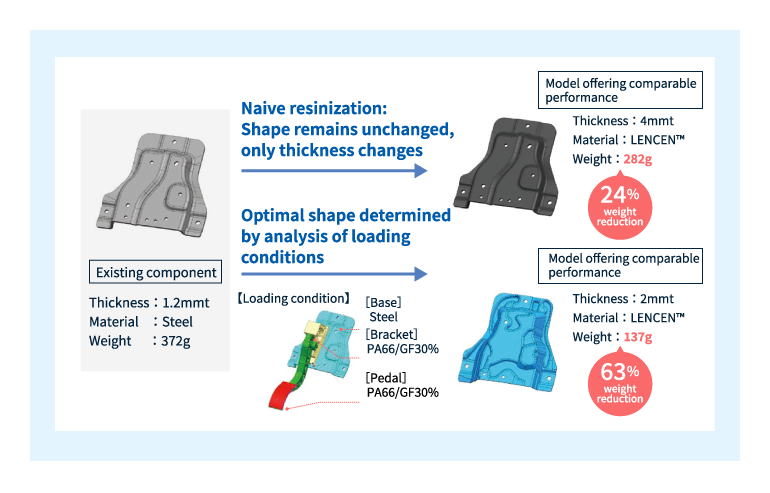
It enables the integral molding of complex shapes, offering a high degree of design freedom, reducing the number of parts, and improving performance through shape optimal.
Energy saving effect due to weight reduction
In vehicles and aircraft, the use of lightweight FRP (fiber-reinforced plastic) materials improves energy efficiency. Reducing vehicle weight leads to reduced fuel consumption and CO₂ emissions, and FRP is attracting attention from the perspective of reducing environmental impact.
Lightweighting and improved fuel efficiency of automobiles using FRP
Uses of FRP (Fiber Reinforced Plastic)
Due to its excellent performance and cost-effectiveness, FRP is used in a wide range of applications, from everyday products to industrial fields.
For example, its use is increasing in a wide range of fields, including the hulls of small vessels, aircraft parts, the bodies and interiors of automobiles and railway cars, and residential equipment such as prefabricated bathrooms and septic tanks.
glass-fiber reinforced plastic (GFRP), made using glass-fiber, is relatively inexpensive and widely used in general applications such as bathtubs and tanks. Carbon fiber reinforced plastic (CFRP), made using carbon fibers, is used in aircraft components and sports car bodies where high strength and ultra-lightweight are required. In particular, in automobiles and aircraft, the adoption of CFRP as a structural material reduces the weight of the vehicle body and greatly contributes to improved fuel efficiency (energy saving).
Applications of FRP (Fiber Reinforced Plastic) (Image)
Notable technological trends in FRP (Fiber Reinforced Plastics)
Recyclability of thermoplastic composite materials (CFRTP/GFRTP)
Conventional thermosetting resins such as epoxy resins and unsaturated polyesters cannot be remelted once they form a cross-linked structure, making it essentially impossible to recycle FRP as a whole (resin + fiber). For this reason, it is considered difficult to "reuse" thermosetting FRP as a material. On the other hand, because carbon fiber is expensive, research is underway to recover only the carbon fiber, rather than the FRP as a whole. Specifically, methods are being considered to remove the resin through thermal or chemical decomposition and reuse the fibers individually, but challenges such as fiber degradation and cost remain.
In contrast, composite materials using thermoplastic resins (CFRTP/GFRTP) can be remolded as FRP because the resin softens again when heated, making them highly recyclable as composite materials. However, there are challenges unique to thermoplastics, such as resin degradation due to increased molding cycles and weakening of the interface with the fibers.
| thermosetting FRP (Epoxy resin, unsaturated polyester, etc.) |
thermoplastic FRP (CFRTP/GFRTP) |
|
|---|---|---|
| resin structure | crosslinked structure (Three-dimensional network structure) |
Linear or branched polymers |
| Behavior during heating | It will not remelt. (It decomposes with heat) |
It softens again and becomes liquid. |
| Reuse as FRP | Basically impossible (Cannot be remolded) |
remouldable |
| Common challenges | Recycling of individual fibers after resin has been removed. | Resin degradation, weakening of the interface |
| Main recycling approaches | Fiber recovery through thermal and chemical decomposition | Reshaping by heating |
Cost reduction through hybrid molding (organosheet + injection molding)
In FRP molding, thermosetting FRP has been the mainstream, and autoclave curing and RTM molding have been widely used as typical molding methods. In these processes, it is necessary to wait for the resin to cure, and the long cycle time due to curing and cooling is a major obstacle to mass production.
In contrast, thermoplastic prepreg sheets (organosheets) have a short heating and molding cycle, making them suitable for mass production. Furthermore, hybrid molding is possible, allowing for the integration of reinforcement and rib shapes with injection-molded resin. Combining this with injection molding can lead to functional integration and cost reduction through process elimination.
Reduced molding time through hybrid molding
Asahi Kasei 's FRP "LENCEN™" is lightweight yet boasts excellent mechanical strength.
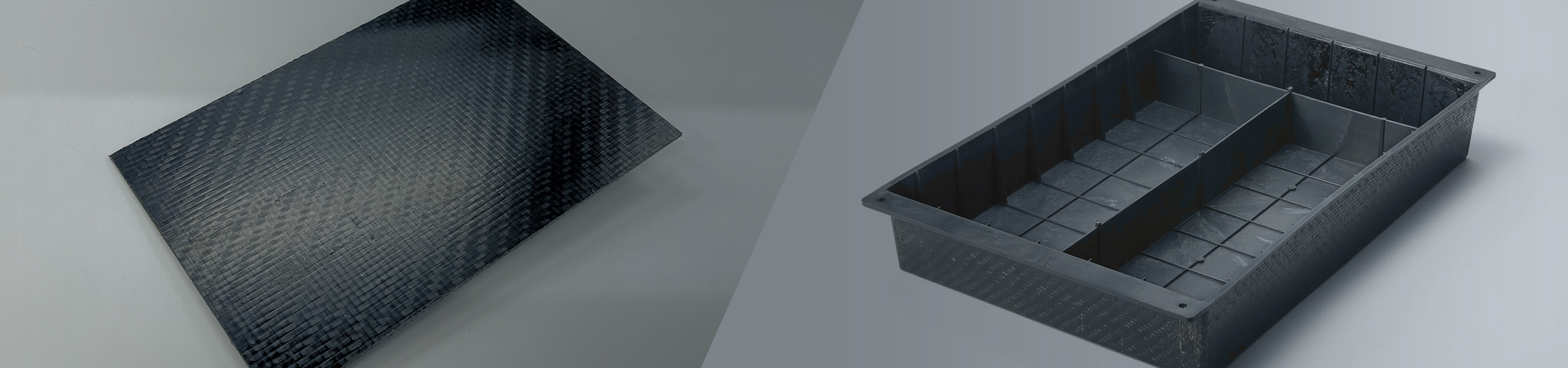
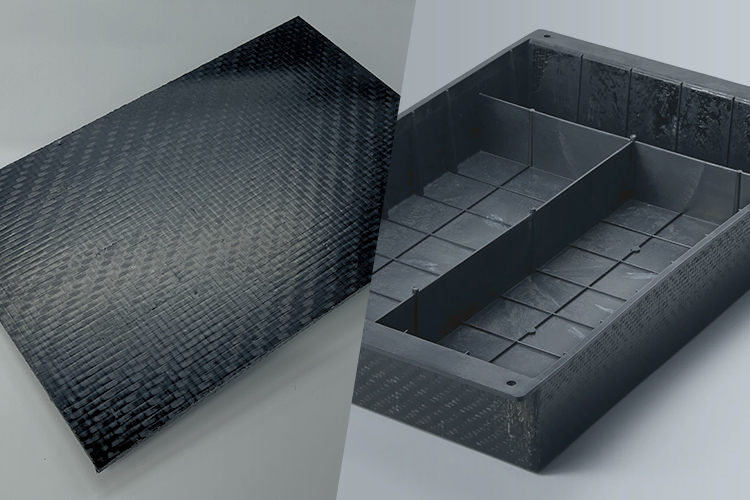
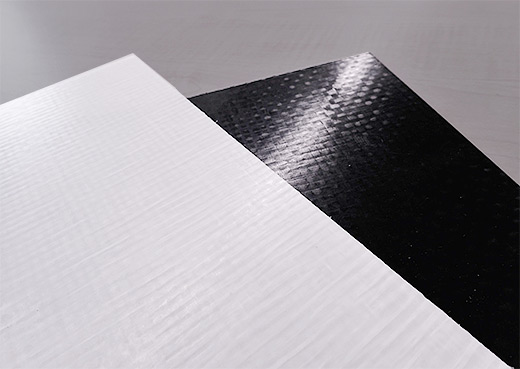
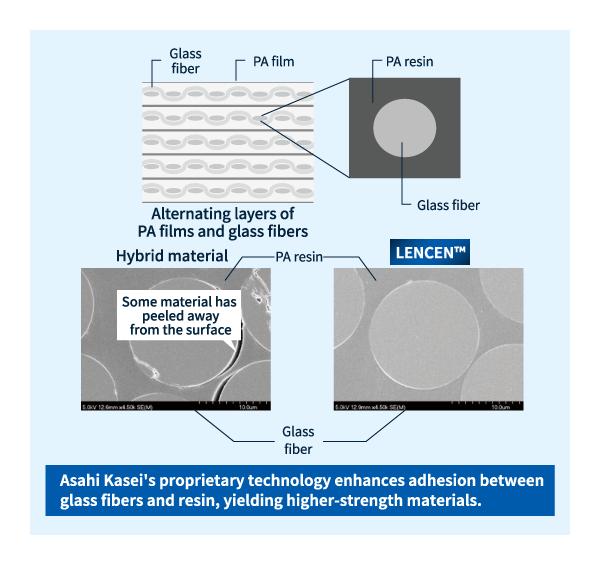
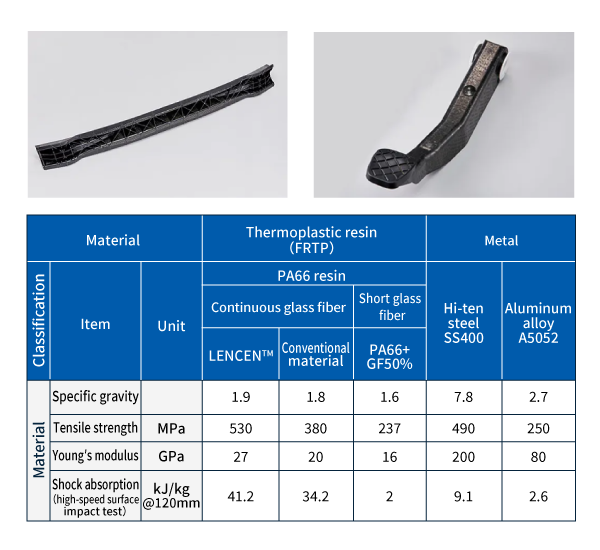
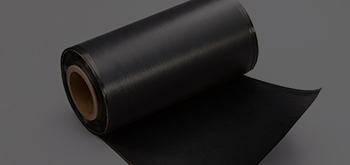
Asahi Kasei 's thermoplastic Continuous Glass Fiber Reinforced Polyamide Resin "LENCEN™" is a fiber reinforced plastic (FRP) made by laminating a continuous glass-fiber fabric with a polyamide 66 (PA66) film. It is attracting attention as a material that achieves significant weight reduction and design flexibility while possessing strength and stiffness comparable to metal materials.
Features of Asahi Kasei 's FRP "LENCEN™"
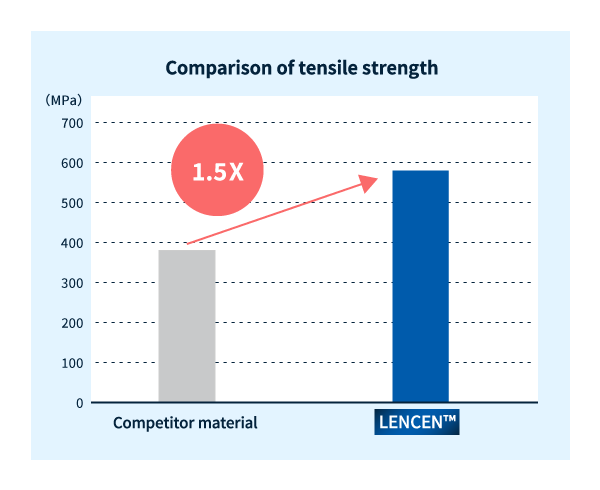
- High strength and stiffness: Asahi Kasei unique technology improves the adhesion between glass-fiber and resin, resulting in high strength. LENCEN™ possesses tensile strength and impact absorption properties equivalent to or greater than that of metals, which is expected to improve collision safety and reduce weight.
- Continuous Glass Fiber Reinforced Polyamide Resin reinforcement: Because the fibers are arranged without interruption, the mechanical strength and stiffness in a specific direction can be dramatically increased.
- Woven fabrics: They offer well-balanced mechanical properties in multiple directions and are easy to handle (stability when laminated).
Comparison of Asahi Kasei 's FRP "LENCEN™" with other materials
| material | Density (g/cm³) | Tensile strength (MPa) | Tensile modulus (GPa) |
|---|---|---|---|
| LENCEN™ (PA66 + Continuous Glass Fiber Reinforced Polyamide Resin) 23℃ 50%RH |
1.9 | Approximately 480 | about 25 |
| steel (590MPa class high tensile steel) |
7.9 | Approximately 590 (surrender 420) | Approximately 200 |
| aluminum (A6063 alloy) |
2.7 | Approximately 185 (surrender 145) | about 70 |
*The above are representative values. Even with the same resin or fiber, physical properties can vary depending on orientation, content, and temperature and humidity conditions.
As described above, LENCEN™ possesses high strength and specific strength, giving it sufficient performance potential to be considered as a replacement for metals in resins.
Furthermore, because LENCEN™ is a composite material, improvements in overall performance and cost can be expected through integrated molding with dissimilar materials and functional integration.
If you have any questions, concerns, or would like to request samples of Asahi Kasei 's FRP "LENCEN™", please feel free to contact us.
About the Author
- Daichi Tokura
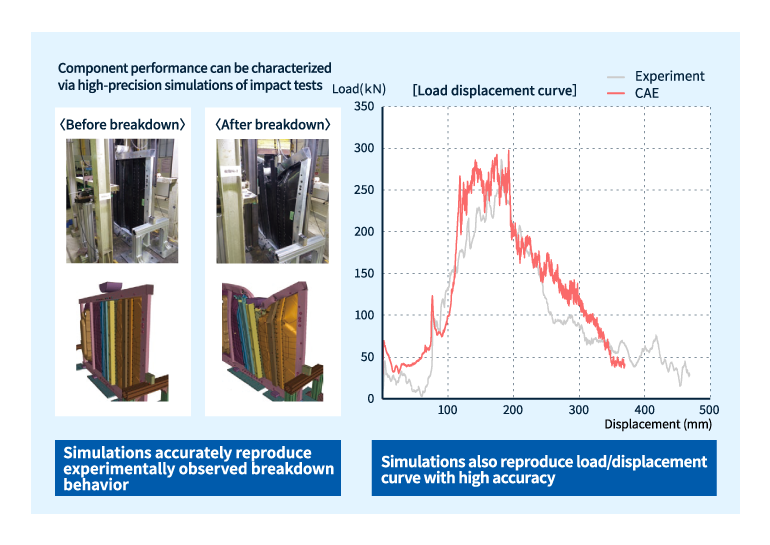
Asahi Kasei Corporation / Functional Materials Division / Rensen Business Promotion Office / Technology Development Group - Joined Asahi Kasei Corporation in 2018. Engaged in the development of molding technology and CAE technology for Continuous Glass Fiber Reinforced Polyamide Resin reinforced thermoplastic composite material "LENCEN™" and promoting application development utilizing structural and morphological analysis technologies.
We welcome your questions and inquiries regarding our products and technologies.