Technology and Product Introduction
Development of CNF-reinforced resin for 3D printers

For inquiries regarding SDS and various chemical substance surveys, please submit your request through your trading company or other purchasing route.
We appreciate your understanding and cooperation.
Update date:
2026.09.17
|Release date:
2026.09.17
Technology and Product Introduction
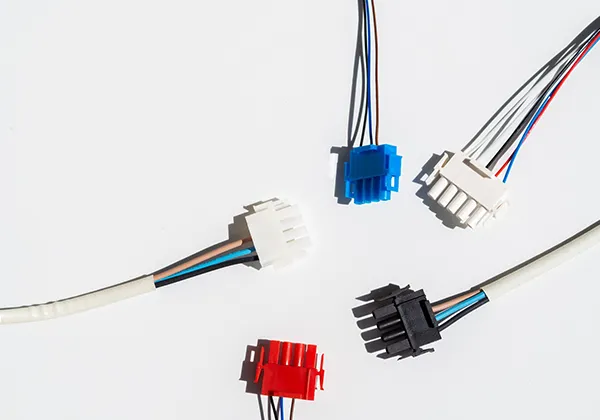
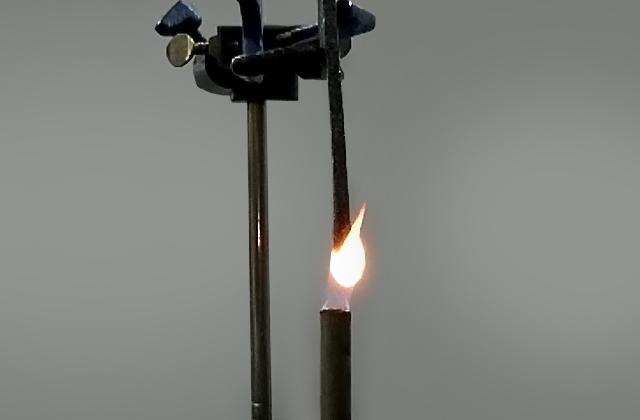
In recent years, there has been a glowing need to comply with the international certification standard IEC60335-1, particularly for consumer electronics connectors destined for Europe. This standard allows for the simplification or elimination of certification testing (GWEPT) on the final product by using materials with high glow wire properties (GWIT, GWFI).
In response to these market demands, Asahi Kasei has developed LEONA™ High Glow Wire Flame retardant Grade (a product under development), which features high glow wire, high toughness, and non-halogen Flame retardant polyamide, through advanced material design and unique compounding technology.
However, in general, improving glow wire performance can increase the risk of cracking. This material overcomes that challenge and is a new flame-retardant polyamide that combines flame resistance, ignition resistance, and crack resistance.

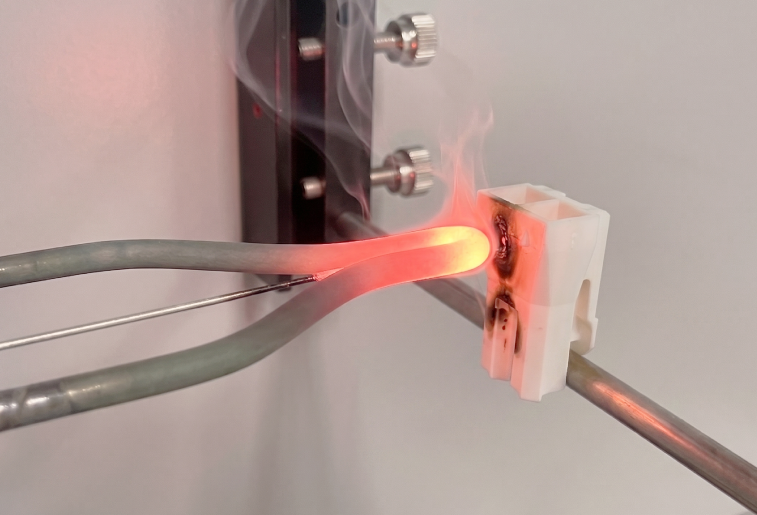
Even when materials satisfy the exemption criteria for glow wire testing (GWEPT) in final products such as connectors—namely, "GWFI 850°C or higher" and "GWIT 775°C or higher". In recent years, GWEPT has often been required despite meeting these exemption criteria.
The no-ignition criterion for GWEPT is a burn time of less than 2 seconds during 30 seconds of contact with a wire at 750°C. This is a stricter requirement than the no-ignition criterion used in GWIT testing on a flat plaque.
This material achieves a GWFI of 960°C and a GWIT of 850°C, and even at a wire temperature of 800°C on a 3.0mm thick test plate without ignition during wire contact. Therefore, it is suitable for applications requiring GWEPT compliance.
→ Click here for more details on glow wire testing (IEC 60695)
Generally, the addition of large amounts of flame-retardant additives makes materials more prone to cracking. This material maintains performance equivalent to conventional high glow wire flame retardant grades while significantly improving toughness. The tensile test results shown in the figure below demonstrate that the material fractures while elongating even after yielding, indicating higher toughness compared to conventional materials.
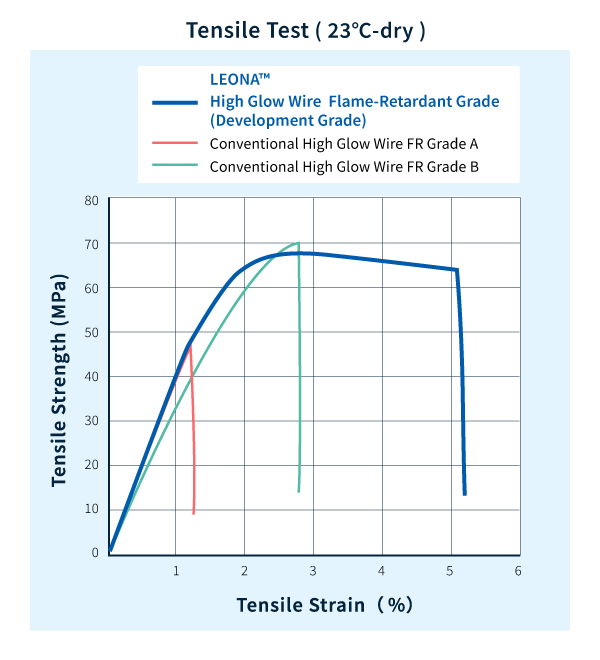 toughness evaluation by tensile testing
We conducted fitting tests on molded parts with a snap-fit* tests under conditions simulating actual use. As a result, we confirmed that the parts are resistant to repeated deformation and possess high mechanical reliability.
*A snap-fit is a joining mechanism that secures parts using the elastic deformation and restoring force of the material and therefore requires sufficient toughness. (These physical properties are measured values obtained by a defined method and are not guaranteed values.)
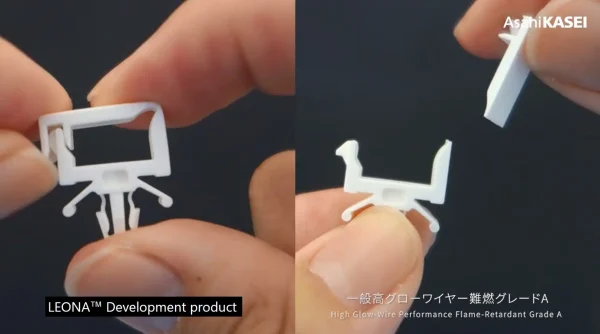 Snap-fit Toughness Evaluation
This non-halogen flame-retardant material has achieved a CTI of 600V (IEC 60112, ASTM D3638) in tracking resistance evaluation. It contributes to reducing the risk of leakage and short circuits, and enables miniaturization of components by shortening the required creepage distance.
With these features, it enables both high flame resistance and mechanical reliability. In particular, it contributes to greater design freedom for components that require both flame resistance and mechanical strength, such as connector components with snap-fit structures and locking mechanisms, terminal blocks, and electrical components.
For feasibility studies, detailed evaluation data, or potential applications, please feel free to contact us.
Please contact us to ask any questions, discuss any concerns, and request samples.
Adding this site as a preferred source in Google search results will make it easier to find articles from Asahi Kasei engineering plastics Comprehensive Information Site.

Technology and Product Introduction
Technology and Product Introduction

Technology and Product Introduction
Technology and Product Introduction

Technology and Product Introduction
Technology and Product Introduction

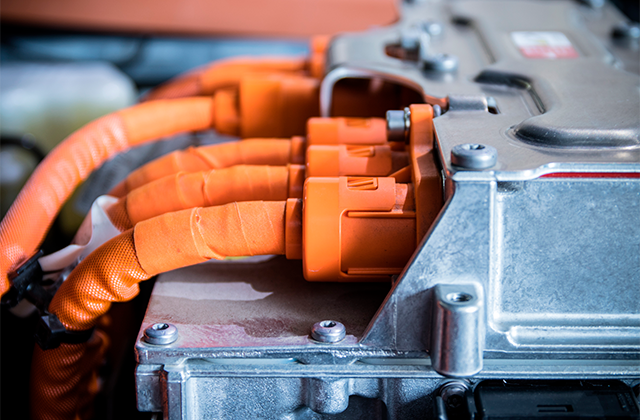
High-voltage connectors used around the batteries of electric vehicles.
Orange color is required to alert the user to the high voltage. Flame retardancy and tracking resistance are required.
 :
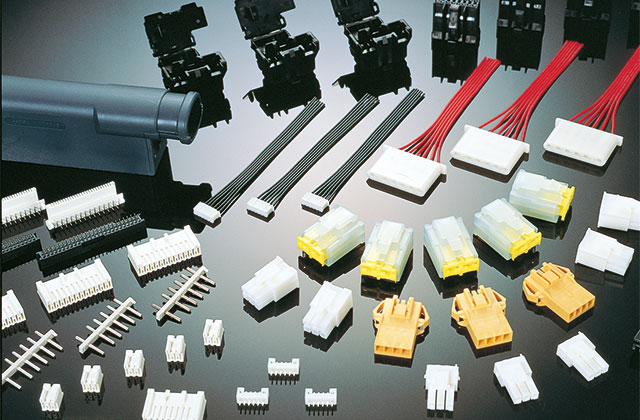
Components and devices used to connect cables to each other and to connect power and electrical signals.
Flame resistance, tracking resistance, strength, toughness, etc. are required.
Please feel free to contact us with any questions regarding our products and technologies, or if you would like to request samples.
We will provide a more detailed introduction to Asahi Kasei 's engineering plastics products and technologies.
We will regularly deliver product and industry information. Please use this for your information gathering.