- TOP
- Basic Knowledge engineering plastics
- Glow-wire testing (IEC 60695) – Key points for material selection to exempt product testing –
What is Glow Wire test (IEC 60695)?
—Key points for selecting materials to exempt you from product test—
This article provides an overview of the glow-wire test specified in IEC 60695, which is an important safety evaluation method for household appliances and electrical components. It also explains the key considerations when selecting materials that may allow the final product to be exempted from the Glow-Wire End-Product Test (GWEPT).
Update date:
2026.09.17
|Release date:
2026.09.17
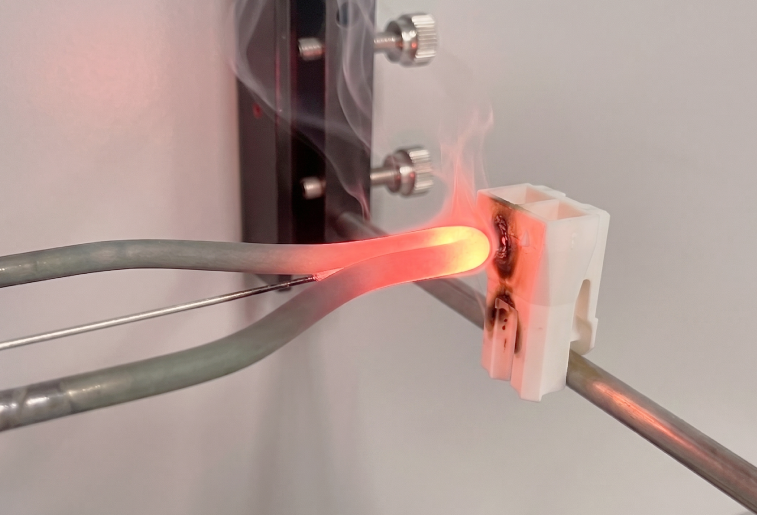
Table of Contents
- Why is glow wire testing necessary?
- Glow Wire test (IEC 60695) as a test to evaluate ignition resistance.
- Overview of Glow Wire test (IEC 60695)
- Exemption rules for Glow Wire test of the final product
- Glow Wire test challenge: Failure in glow wire test of the final product.
- Challenges with high glow Wire materials: Reduced toughness due to increased flame retardance.
- Suggestion:
A material that solves the problem: "LEONA™ High grow wire flame retardance Grade" (product under development)


Why is glow wire testing necessary?
Appliances that operate unattended, such as refrigerators and air conditioners, and electrical appliances that reach high temperatures, such as electric kettles, may pose a fire risk due to malfunctions in switches and electrical contact points including short circuits, arcing and poor electrical contact.. For this reason, the resin components used at these appliances are required to have high "ignition resistance" to prevent fires from occurring in the first place (e.g., IEC 60335-1).
 Examples of causes of home appliance fires
The glow wire test as a method for evaluating resistance to ignition
Traditionally, the vertical combustion test (below figure), defined in UL94 published by UL (Underwriters Laboratories), has been widely used to evaluate flammability of plastic materials. This test evaluates the resistance to burning and the fire spread against "direct flames" from an external source. It is an effective evaluation method from the perspective of providing occupants with sufficient time to evacuate.
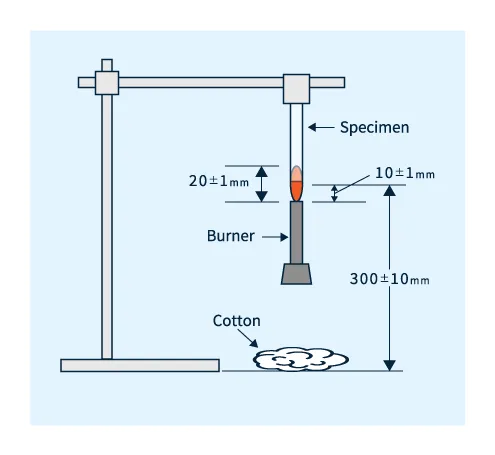 UL94 Vertical burn test
However, actual household appliances may be exposed to overheating caused by overcurrent or poor electrical contact. To evaluate a material’s resistance to ignition under such conditions, the International Electrotechnical Commission(IEC) developed the glow-wire tests specified in IEC 60695.(below figure)
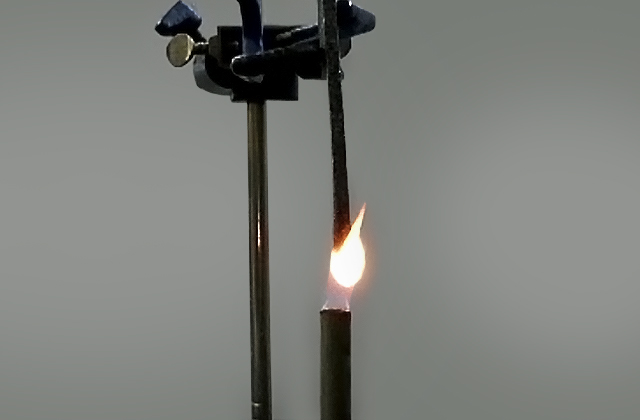
In these tests, a heated glow wire is pressed against a test specimen. The specimen is then evaluated based on whether ignition occurs, its burning behavior, and whether flaming droplets ignite the specified layer placed beneath it. (video).
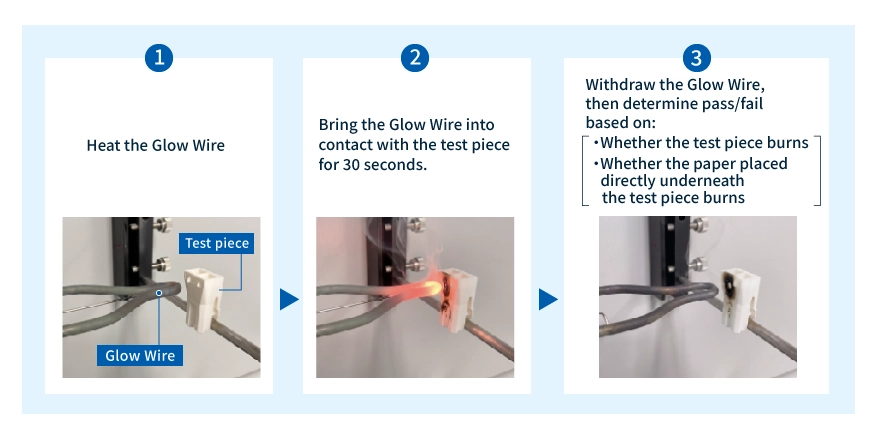 Glow Wire test method
Grow wire test in progress
Overview of Glow Wire test (IEC 60695)
Glow Wire testing can be broadly classified into two categories: "testing on the final product" and "testing on Materials."
| Target | standard | Test Details |
|---|---|---|
| Final product | GWEPT (Glow Wire Test, performed on end product, Glow Wire testing of the final product (IEC 60695-2-11) |
Tests performed on the final product (component) itself, such as connectors. |
| Materials | GWFI (Glow Wire Flammability Index) Glow Wire flammability index (IEC 60695-2-12) |
The highest temperature at which the flame is extinguished within 30 seconds after the glow wire is separated from the test piece, and no ignition occurs due to dripping material. |
| GWIT (Glow Wire Ignition Temperature) Glow Wire ignition test (IEC 60695-2-13) |
The maximum temperature at which ignition does not occur for more than 5 seconds while the glow wire is pressed against the test piece. |
Exemption rules for glow wire testing of the final product
The safety standard for household appliances (IEC 60335-1) imposes strict requirements on household appliances that operate unsupervised with currents exceeding 0.2A. However, there is a rule (below flowchart) that exempts the final product from Glow Wire test (GWEPT) if material is certified for glow wire test.
GWEPT is waived if materials that meet the following requirements are used.
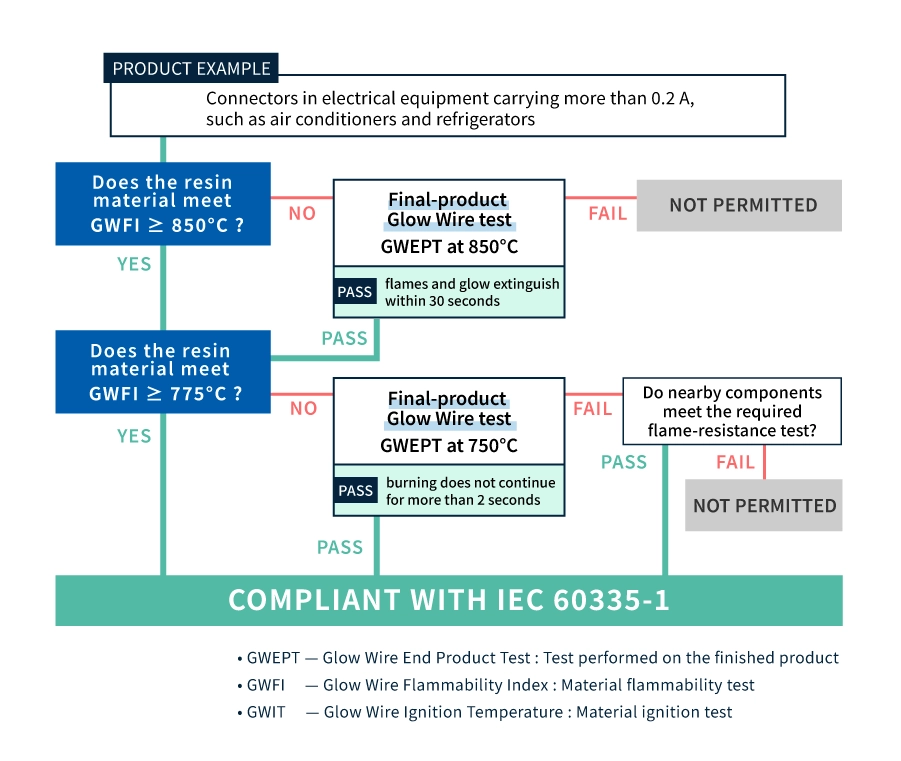 Flowchart for determining exemption from glow Wire test (GWEPT) for the final product.
Challenge in Glow Wire Testing: Failure of the Final Product
While the standard allows for exemption from GWEPT with a GWIT of 775°C, there are some points to note. Even when using materials that meet the above rules, the way heat is transferred changes depending on the product shape (such as changes in wall thickness or the presence or absence of air gaps), and there have been cases where products fail GWEPT when actually performed. Therefore, from the perspective of reducing the risk of design changes and evaluation variability in the final product, it is effective to select materials that not only satisfy the required GWIT of 775°C but also have a higher certified temperature in GWIT.
Furthermore, GWIT is a test that confirms that "the burning time is less than 5 seconds even when ignition occurs under specified conditions," and it is not a test that guarantees no ignition. Therefore, the GWIT certified temperature and the actual no-ignition temperature are not necessarily the same, and there may be differences between certified materials.
Challenges Associated with High Glow Wire Performance Materials
On the other hand, high glow wire materials with a GWIT exceeding 800°C generally have a large amount of flame retardance added. When the amount of flame retardance added increases, Materials faces problem in terms of toughness. Low toughness of material makes the following product defects more likely to occur.
- The snap-fit connectors and other parts that secure components break due to deformation (below: left figure).
- The boss cracks when tightening the screw (self-tapping) because it cannot withstand the stress (below right figure).
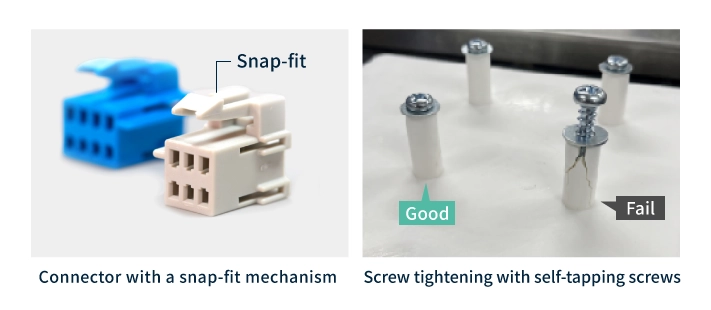 Examples of structures need toughness
Proposed Solution:
LEONA™ High Glow Wire Flame-Retardant Grade(Under Development)
Highly reliable products require ignition resistance to ensure safety and high toughness during assembly. Traditionally, achieving both high glow wire performance and toughness has been challenging.
However, through our unique formulation and advanced compounding technology, we have developed the LEONA™ High Glow Wire flame- retardance grade (development product), which combines these two properties. Our internal tests have shown it can withstand GWIT 850℃ (3mm thickness), potentially exempting it from final product testing. Furthermore, we have confirmed that it does not ignite at 800℃ (3mm thickness). We believe this will contribute not only to meeting standards but also to securing design margins in final product evaluation and reducing the risk of design changes.

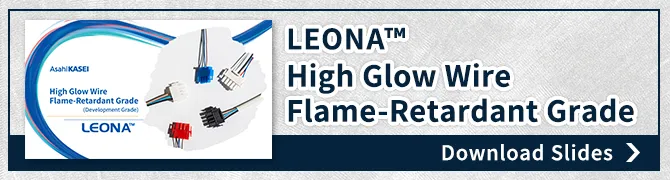
Asahi kasei offers product numbers with excellent grow-wire resistance. Please feel free to contact us regarding materials suitable for high grow-wire applications.
Asahi Kasei offers engineering plastics that comply with Glow Wire testing (IEC 60695) to suit your application and purpose. Please feel free tocontact us with any questions, inquiries, or sample requests.
About the Author
- Ryosuke Yokoo (Asahi Kasei Corporation / Functional Materials Application Development Department)
- Joined Asahi Kasei Corporation in 2016. Gained experience in material design and development of LEONA™ Flame retardance grades in the Technology Development Department. Currently, in the Functional Materials and Applications Development Department, responsible for material proposals and technical services, primarily focusing on Flame retardance polyamides. Engaged in application development based on safety evaluations required for materials used in electrical and electronic components, such as Glow Wire testing and UL standards.
About the Author
- Kenta Hiwatashi (Asahi Kasei Corporation / Functional Materials Application Development Department)
- Joined Asahi Kasei Corporation in 2017. As a technical engineer, I am engaged in providing application proposals and technical services to customers, mainly focusing on Flame retardance grades such as LEONA™ S series and PN series.
Please contact us to ask any questions, discuss any concerns, and request samples.
Easy to find on Google
Adding this site as a preferred source in Google search results will make it easier to find articles from Asahi Kasei engineering plastics Comprehensive Information Site.

Others



Related Information