Glow-wire testing (IEC 60695)
– Key points for material selection to exempt product testing –

For inquiries regarding SDS and various chemical substance surveys, please submit your request through your trading company or other purchasing route.
We appreciate your understanding and cooperation.
This article provides an overview of UL 2597, "Outline of Investigation for Test Method for Materials for Use in Transportation Applications: Surface Tracking Test (STT) Method" (hereinafter referred to as "STT"), a new tracking-resistance test standard published by UL Standards & Engagement in May 2025.
Update date:
2026.08.25
|Release date:
2026.08.25

This article provides an overview of UL 2597, "Outline of Investigation for Test Method for Materials for Use in Transportation Applications: Surface Tracking Test (STT) Method" (hereinafter referred to as "STT"), a new tracking-resistance test standard published by UL Standards & Engagement in May 2025.
Demand for electric vehicles (EVs) has been rising in recent years, yet there remains room for improvement in areas such as driving range and battery charging time. To increase the charging speed in particular, the industry is shifting from conventional DC charging voltages of 300–400 V toward 800 V architectures, and the electrical performance requirements for materials used in these systems are expected to become increasingly stringent.
However, the conventional tracking-resistance test standard — "Method for the Determination of the Proof and the Comparative Tracking Index of Solid Insulating Materials" (hereinafter "CTI"), based on IEC 60112 and ASTM D3638 — is limited to a maximum voltage of 600 V, leaving a gap for higher-voltage applications.
With the publication of UL 2597 by UL Standards & Engagement, tracking-resistance testing is now possible at voltages of up to 900 V.


The most significant difference between STT and CTI is the maximum testable voltage (STT: 900 V; CTI: 600 V). The two methods also differ in electrode spacing and electrode orientation. The table below summarizes the key differences.
| Item | STT | CTI |
|---|---|---|
| Surface Tracking Test | Comparative Tracking Index Test | |
| Test standard | UL2596 | IEC60112 |
| Maximum voltage | 〜900V | 〜600V |
| Electrode spacing | 6mm±0.1mm | 4mm±0.1mm |
| Electrode orientation | Inverted (sharp edge facing outward) | Standard (sharp edge facing inward) |
| Other | The test equipment and electrolyte used are similar | |
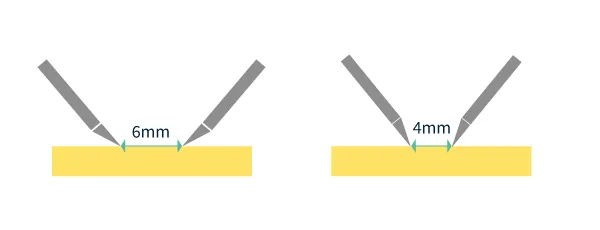 Differences Between STT and CTI
The STT in accordance with UL 2597 standard were conducted to assess LEONA™ “Development Grade” and LEONA™ SN series which is halogen Free (Certified to UL94 V-0).
LEONA™ “Development Grade” achieved the highest rating available in the STT with 900 V and LEONA™ SN Series achieving the rating of 800 V.
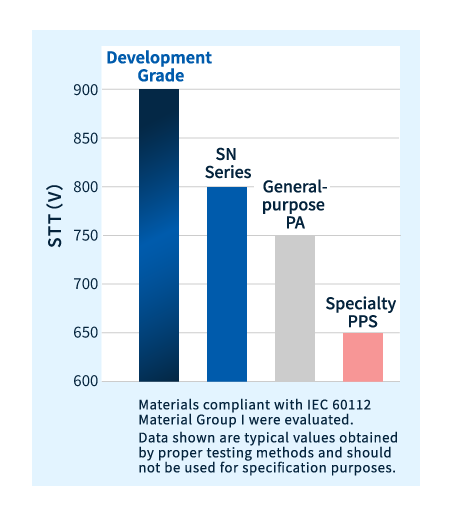 Comparison of STT Evaluation Results for LEONA™ and Other Resins
Feel free to contact us about our tracking-resistance materials.
Asahi Kasei offers engineering plastics tailored to a range of applications and design requirements, with compliance to tracking-resistance tests including IEC 60112 and UL 2597. Please feel free to contact us with any questions, consultation requests, or sample inquiries.
Please contact us to ask any questions, discuss any concerns, and request samples.
Adding this site as a preferred source in Google search results will make it easier to find articles from Asahi Kasei engineering plastics Comprehensive Information Site.

Please feel free to contact us with any questions regarding our products and technologies, or if you would like to request samples.
We will provide a more detailed introduction to Asahi Kasei 's engineering plastics products and technologies.
We will regularly deliver product and industry information. Please use this for your information gathering.